
The quick take
Choose 3D printing for low volumes, fast turnaround, design changes and hidden or structural parts, and choose injection molding for higher volumes and any visible, aesthetic part that has to look factory-correct. The line is mostly volume: molding needs tooling that runs $2,000 to $10,000 for aluminum and $10,000 to over $100,000 for steel, so it only pays off once that cost spreads across enough parts, with a break-even typically around 500 to 5,000 units. But appearance can override the volume math on its own, since a printed surface carries layer lines that read as aftermarket where a molded one looks factory.
The one factor that decides most cases: volume
The whole comparison starts with how many parts you need, because that single number determines whether tooling can ever pay for itself.
Injection molding has a large fixed cost before the first part exists: the mold. That tool must be designed and machined, and its cost does not change whether you make one part or a million. Once it exists, each part is cheap, often $0.50 to $5.00. 3D printing has the opposite shape: no tooling cost at all, but every part costs roughly the same to produce, since the printer spends the same time and material on part number two as on part number two thousand.

Plotted against volume, the two cost curves cross at a predictable point:
-
Below the crossover, 3D printing is cheaper, because you avoid a tooling bill that would never be recovered.
-
Above the crossover, molding is cheaper, because the tooling cost divided across many parts becomes trivial and the low per-part cost dominates.
-
Far above it, at 10,000 units and beyond, molding is almost always the cheapest option available and nothing else competes.
Everything else in this comparison is a refinement of where exactly that crossover sits.
Where the break-even actually falls
The crossover is not a single number, because it moves with tooling cost, which moves with the mold material and part complexity.
A worked example makes it concrete. A $5,000 aluminum mold producing 3,000 parts at $0.80 each totals $7,400. Printing those same 3,000 parts at roughly $2.50 each totals $7,500. At that volume the two are a wash, which is why the general break-even is quoted at 500 to 5,000 units. Cheaper tooling drags the crossover down: simple aluminum rapid tooling can shift it to as low as 100 to 300 parts. Expensive steel tooling pushes it up, but the per-part savings above it are larger.
The rules of thumb that fall out of this:
-
Under a few hundred parts, print. Tooling will not pay back.
-
A few hundred to a few thousand, it depends on tooling cost, part cost and how many revisions you expect. This is the genuine grey zone.
-
Over roughly 5,000 to 10,000 parts, mold. The economics are decisive.
If your honest annual volume for a part is in the dozens or low hundreds, you are almost never molding, no matter what the part is.

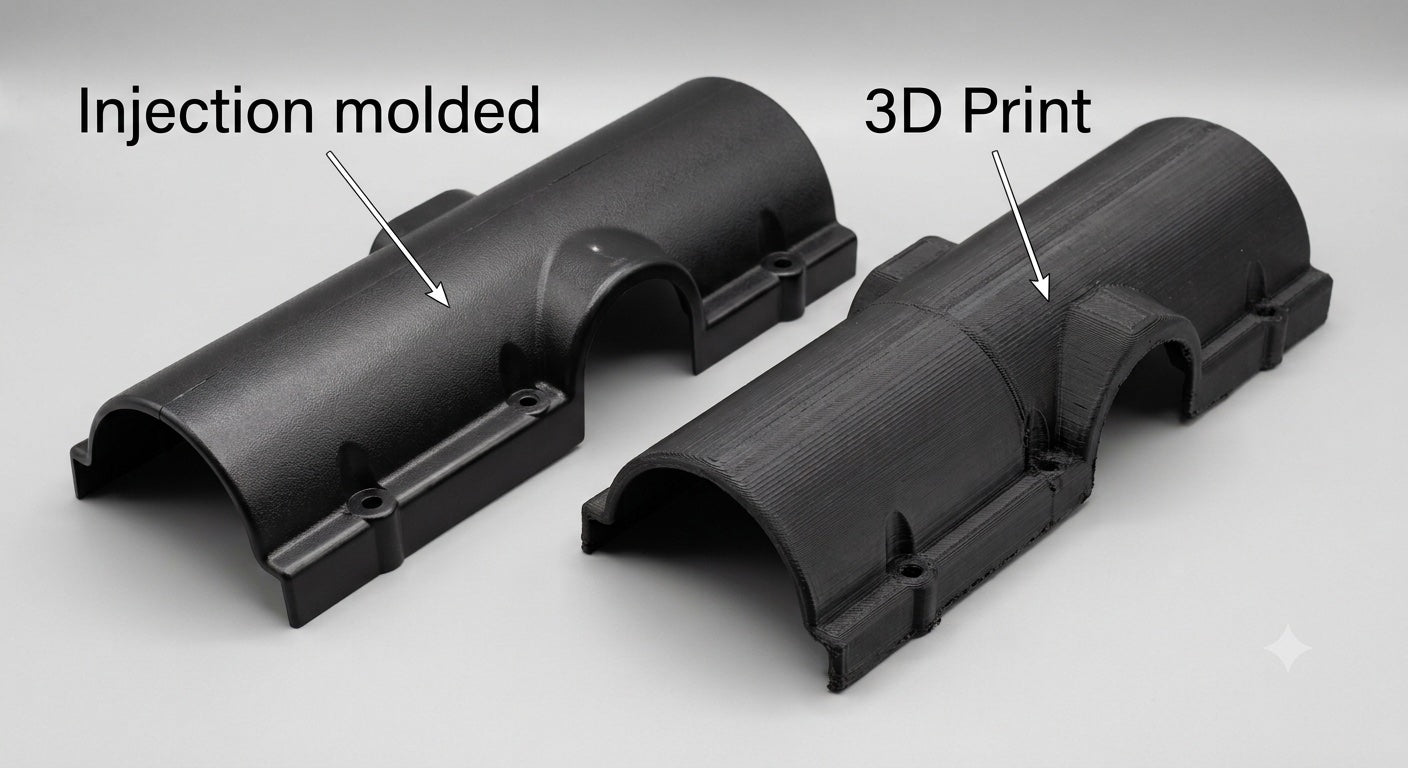
This photo shows our S13 LHD and RHD stereo surround trims which are molded. Typically, minimum order quantities (MOQ's) for injection molded parts lands in the hundreds of pieces per order
Beyond cost: five things that move the decision
Volume sets the baseline, but five other factors can override it in either direction.
Appearance. This is the one that overrides everything else on a visible part. A molded part comes out with a smooth, uniform, factory-grade surface. A printed part, however well made, carries fine layer lines that read as aftermarket on a surface someone looks at. For a hidden bracket that nobody sees, that does not matter. For a visible piece of interior trim, it matters more than cost or volume, and it is why aesthetic parts get molded even at volumes where printing would be cheaper.

Macro comparison showing the surface finish differences between an injection molded part and a 3D printed part
Lead time. A mold takes weeks to design and cut before the first part appears. A printed part can be in hand in days. If you need parts now, or need to hit a deadline that a tooling lead time would blow, printing wins regardless of volume. This is why even high-volume manufacturers often print early production parts while the mold is being made.
Design stability. Every change to a molded part means altering or recutting the tool, which is slow and expensive. A change to a printed part is a file edit and a reprint. If the design is not finalised, or if you expect to iterate, printing protects you from paying for tooling twice. Molding rewards a design that is locked; printing forgives one that is not.
Geometry. Some shapes favour each method. Molding struggles with deep undercuts and fully enclosed internal channels without complex, costly tooling. Printing produces those geometries directly, since it builds up in layers rather than filling a cavity. Conversely, very large flat parts or extremely thin walls can be easier to mold consistently.
Material. The two processes do not offer identical material menus. Some engineering polymers are straightforward to print but awkward to mold at low volume, and some are the reverse. If a part needs a specific material, check that the material is practical in the process before the volume math, because a material constraint can settle the question on its own.
The comparison, side by side
Here is the whole decision on one view.
|
Factor |
3D printing wins when |
Injection molding wins when |
|---|---|---|
|
Volume |
dozens to low thousands |
thousands to millions |
|
Appearance |
part is hidden or structural |
part is visible and aesthetic |
|
Tooling cost |
none |
$2,000 to $100,000+ up front |
|
Per-part cost |
flat, roughly $2 to $5 |
low, $0.50 to $5 after tooling |
|
Lead time |
days |
weeks for the tool |
|
Design changes |
cheap, a file edit |
slow and costly, recut the tool |
|
Complex internal geometry |
handles it directly |
needs expensive tooling |
|
Best fit |
prototypes, custom, hidden, low volume |
visible trim, mass production |
The pattern is that printing wins on flexibility, low volume and hidden parts, while molding wins on scale, unit cost and any surface someone will look at. They are not really competitors so much as tools for different jobs.
The automotive case: why the method depends on the part
For classic car parts, the choice is decided by two things together: how many you will make, and whether anyone looks at the part. Neither alone settles it.
The market for any given classic part is tiny. A piece that fits one year of one model might have a few hundred possible buyers in the entire world. That low volume rules out a mold on cost grounds for a hidden or structural part, where a printed component in the right engineering filament is more than strong enough and nobody sees the surface. A bracket, a mount, a gauge adapter behind the cluster: these are printed, because printing is the only method that pays at the volume and the finish is irrelevant.
Visible interior trim is a different question. A dash panel, a console piece, a surface someone runs their eye across every drive has to look factory-correct, and a printed surface carries fine layer lines that read as aftermarket. For those parts the appearance factor overrides the volume math: they are molded, even though the volume alone would point to printing, because the finish is the whole point. Producing them means committing to tooling, which is why they tend to be the more established parts in a catalog rather than one-offs.
So the honest rule for a classic part is not printing versus molding as rivals. It is a division of labour:
-
Hidden, structural, custom and prototype parts are printed, made to order in engineering filament, revisable because they live as a CAD file.
-
Visible aesthetic trim is molded, tooled up once the design is proven, for a surface that looks like it left the factory.
A part that no one reproduces still beats the alternatives either way, whether that is an aging worn original or a slow hand-fabricated one-off. The method just follows what the part needs to be.
How we decide at Lunar Loox
Our rule is simple: we choose the method by what the part has to be, not by habit.
If a part is hidden or structural, a bracket, a mount, a gauge adapter, we 3D print it in the correct engineering filament for where it lives, glass-filled ASA for the cabin and carbon-filled PPS for the engine bay. Printing is the right call there because the volumes are low, the geometry is often bespoke, and the finish is out of sight. We design it in CAD, print a prototype to test against the real car, and revise until the fit is right.
If a part is a visible, aesthetic piece of interior trim, we mold it, because a printed surface would look out of place next to factory materials. We handle the design and run the tooling through our molding partner, so the finished trim has the smooth, uniform surface the interior deserves. That is why our newer aesthetic parts are molded rather than printed: the part earned the tooling by being something you look at.
The result is that owners get the right process for each part rather than one process forced onto everything. If you have a part that needs making, whether it is a hidden custom mount or a visible trim piece, start a request through the Custom Garage and we will build it the way it should be built.
Frequently asked questions
When should you use 3D printing instead of injection molding?
Use 3D printing when you need low volumes, fast turnaround, or the ability to revise the design, since it has no tooling cost and produces parts in days. The break-even against molding is typically 500 to 5,000 units, so below a few hundred parts printing is almost always cheaper because a mold would never pay for itself. Prototypes, custom parts and low-volume production are printing's core territory.
When is injection molding worth the cost?
Injection molding is worth it once you are making the same finalised part in the thousands, because the tooling cost spreads thin across many parts and the per-part cost drops to $0.50 to $5.00. Above roughly 5,000 to 10,000 units it is almost always the cheapest option. It also requires a stable design, since changing a molded part means recutting the tool.
What is the break-even point between 3D printing and injection molding?
The break-even is typically 500 to 5,000 units, depending on tooling cost and part geometry. Cheap aluminum rapid tooling can bring it as low as 100 to 300 parts, while expensive steel tooling pushes it higher. As a worked example, a $5,000 aluminum mold making 3,000 parts at $0.80 each costs about the same as printing those parts at $2.50 each, which is why that region is the genuine grey zone.
How much does an injection mold cost?
An aluminum mold typically runs $2,000 to $10,000, and a production steel mold $10,000 to over $100,000, depending on size, complexity and number of cavities. This is a fixed cost paid before the first part exists, which is why molding only makes sense at volumes high enough to spread it thin. 3D printing avoids this cost entirely, trading it for a higher, flat per-part cost.
Is injection molding stronger than 3D printing?
Injection molded parts are more uniform and strong in all directions, while printed parts are slightly weaker across their layer lines, but the gap is smaller than assumed and often irrelevant. A well-designed printed part in an engineering filament, oriented so loads run along its layers, is strong enough for most interior and many under-hood automotive roles. For low-volume parts where no molded alternative exists, the comparison is moot.
Are classic car parts 3D printed or molded?
Both, depending on the part. Hidden and structural parts such as brackets, mounts and gauge adapters are usually 3D printed, because the volumes are low and no one sees the surface. Visible interior trim is often molded instead, because a printed surface carries layer lines that look aftermarket where a molded one looks factory-correct. The method follows what the part has to be, not a single rule for all classic parts.
Need a part built the right way?
We design and manufacture precision parts for classic Datsun and Nissan, printing hidden and custom parts in engineering filament and molding visible trim through our tooling partner, so each part gets the process it deserves. Tell us what you need through the Custom Garage.
Nicholas Clark is the founder of Lunar Loox, where he designs and manufactures precision interior components for classic Datsun and Nissan chassis.
Sources for figures cited: Jaycon injection moulding price guide 2025, RapidDirect injection molding cost 2026, Hotean, 3D printing vs injection molding break-even, Formlabs, how to estimate injection molding cost
Share:
Datsun 510 Interior Upgrade Guide: Parts and Fixes