
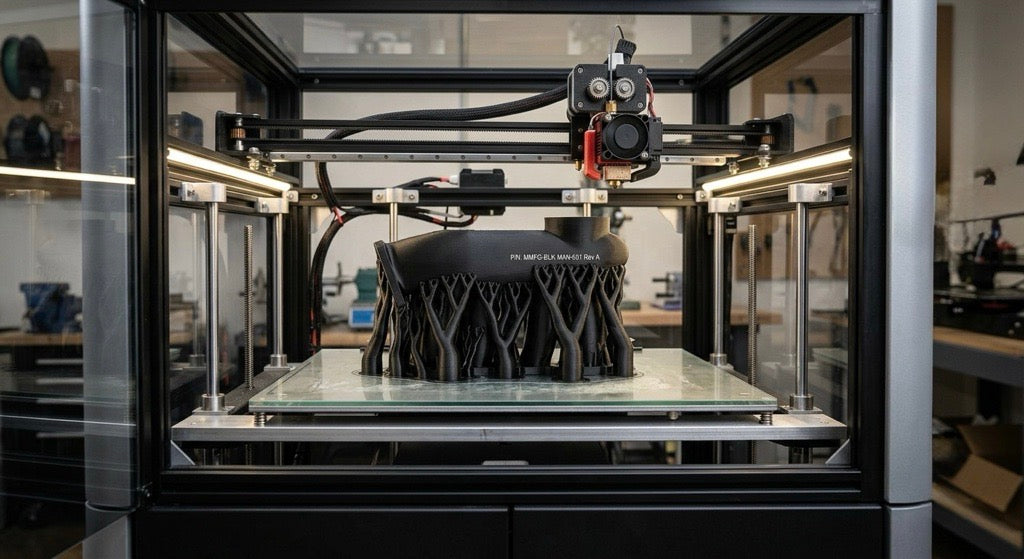
The short answer
3D printed car parts are as durable as the material they are printed in and the engineering behind them, which is why the question has no single answer. A phone-stand printed in cheap PLA will sag on a warm dashboard. A part printed in glass-filled ASA, which holds its shape to around 106°C, will outlast the car's interior it sits in. The skepticism comes from people picturing desk-toy plastic, not engineering-grade filament printed with the layer orientation and wall thickness the load actually requires. Material and design are everything. The words "3D printed" tell you almost nothing on their own.

Why the question keeps coming up
The doubt is reasonable, because most people's first exposure to 3D printing was a brittle trinket that snapped in a drawer.
That trinket was almost certainly PLA, the beginner filament that prints easily and fails early. PLA has a glass transition temperature around 60°C, which means it softens in a hot car before it does anything useful. It is the plastic that gave 3D printing its reputation for fragility, and it deserves that reputation for automotive use. Nobody serious prints functional car parts in it.
The problem is that "3D printed" gets used as if it names a material, when it names a process. Saying a part is 3D printed is like saying a part is "welded" without saying what metal. The process is identical whether the filament is a hobby plastic that fails in a season or an engineering polymer used in genuine under-hood applications. Everything that matters is the material choice and the design, and neither is visible in the phrase.
Durability is three separate questions
A part fails for one of three reasons, and a good part is engineered against all three independently.
-
Heat. Does the plastic soften at the temperature the part will see? A dashboard surface in direct sun reaches 82 to 93°C (180 to 200°F). An engine bay component sees far more. The material's glass transition and heat deflection temperatures decide this.
-
UV. Does sunlight degrade it? Some plastics yellow and grow brittle under UV within a season. Others are formulated to resist it for years.
-
Mechanical load. Will it take the forces of installation and daily use without cracking? This is where print design, not just material, does the work.
A part can be excellent on one axis and fail on another. A filament with great UV resistance that softens at dashboard temperatures is still the wrong choice for a dash part. Judging durability means checking all three against where the part actually lives.
The heat question, with real numbers
Heat is where most cheap 3D printed car parts fail, and it is the easiest to get right if you pick the correct material.
The temperature a part must survive depends entirely on location. Here is what each zone of a car demands, against what common filaments can take:
|
Zone |
Peak temperature |
Needs a filament rated above |
|---|---|---|
|
Shaded cabin, footwells |
50 to 60°C |
most engineering plastics |
|
Dashboard in direct sun |
82 to 93°C |
around 100°C to be safe |
|
Engine bay, near heat sources |
150°C and up |
200°C for continuous use |
Now compare the plastics. PLA softens around 60°C, so it fails on a sunny dash. PETG has a glass transition of 75 to 85°C, which puts a sun-loaded dash part right in its softening zone. Glass-filled ASA holds to around 106°C with a heat deflection temperature of 92 to 97°C, clearing the dashboard with margin. For the engine bay, carbon-filled PPS runs continuously past 200°C with a heat deflection temperature up to 264°C.
The lesson is not that 3D printed parts are weak in heat. It is that the material has to match the zone, and a seller who cannot tell you the material cannot tell you whether the part survives.

The layer-adhesion question, answered honestly
The one real structural difference between a 3D printed part and an injection molded one is that printed parts are built in layers, and the bond between layers is the weakest direction.
This is worth stating plainly because it is true and often glossed over. An FDM printed part can reach 70 to 90% of injection molded strength in the plane of its layers, but only 40 to 75% across them, in the direction the layers stack. Pull a printed part apart along its layer lines and it will give up sooner than a molded part would. This is called anisotropy, and pretending it does not exist is how bad parts get sold.
It is also entirely designable-around. Three things control it:
-
Print orientation. A competent designer orients the part so the load runs along the layers, not across them. The same geometry can be twice as strong depending purely on which way it was printed.
-
Wall thickness and infill. Load-bearing areas get solid walls and dense infill rather than the thin shells a decorative print uses.
-
Fiber reinforcement. Glass and carbon fibers in the filament bridge the layer lines and cut the anisotropy substantially, which is a large part of why engineering filaments are filled.
A bracket designed by someone who understands this will take loads that surprise people who still picture the snapped trinket. A bracket printed carelessly in the wrong orientation will confirm every suspicion. The process did not decide which one you got. The engineering did.
Where 3D printing genuinely beats the alternative
For one-off or low-volume classic car parts, 3D printing is not the compromise option. It is frequently the best one available.
Injection molding produces stronger, more uniform parts, and for a component made by the hundred thousand it wins easily. But the tooling for an injection mold runs into tens of thousands of dollars and only makes sense at volume. For a part that fits a fifty year old Datsun, where the total market might be a few hundred cars, no one is cutting a mold. The realistic choices are a decades-old used part, a fabricated one-off, or a printed part designed in CAD from measurements of the original.
The printed part wins on several fronts here:
-
It can be made at all. Many classic interior parts are simply not reproduced by anyone. Printing is the only way to get a new one.
-
It can be revised cheaply. A fit problem is a file edit and a reprint, not a new $10,000 mold.
-
It can be tailored. Mounting a modern gauge or controller in a car that never came with one is exactly the kind of bespoke geometry printing handles and molding cannot justify.
So the honest answer to whether 3D printed parts are durable is that the good ones are more durable than the aging originals they replace, and they exist for cars the injection molders abandoned decades ago.
How to tell a durable printed part from a fragile one
You cannot see durability, but you can ask three questions that expose it.
What material is it, specifically? A confident, specific answer such as glass-filled ASA or carbon-filled PPS is a good sign. "Durable plastic" or "we're not sure" is not. The material is the single biggest determinant and any serious maker knows theirs exactly.
What is the heat rating, and does it match where the part lives? A dash part should be in a filament rated near or above 100°C. If it is PLA or unspecified, it will not last a summer.
Is the material matched to the location? A maker who uses one filament for the cabin and a different, higher-temperature one for the engine bay is thinking about the application. A maker who prints everything in the same cheap filament is thinking about cost.
Our own parts follow that logic. Interior and dash-mounted components are printed in glass-filled ASA for its heat and UV resistance, and engine bay components in carbon-filled PPS for its far higher temperature and chemical resistance. The material is chosen for the zone, every time.
Frequently asked questions
Are 3D printed car parts as strong as injection molded ones?
Not quite, and any honest maker will say so, but the gap is smaller than most people assume and often irrelevant in practice. A printed part reaches 70 to 90 percent of injection molded strength along its layer lines, and a well-designed one is oriented so the load runs that way. For one-off classic car parts, where no one produces an injection molded alternative, the printed part is compared against an aging used original rather than a new molded one, and it usually wins.
Will a 3D printed part melt in a hot car?
Only if it is printed in the wrong material for where it sits. A dashboard reaches 82 to 93°C in direct sun, which will soften PLA and challenge PETG, but glass-filled ASA holds its shape to around 106°C and is unaffected. The failure people remember is almost always a hobby-plastic part in a location that needed an engineering filament.
Do 3D printed parts break along the layer lines?
They can, because the bond between layers is the weakest direction in an FDM part, at 40 to 75 percent of the in-plane strength. A competent maker designs around this by orienting the part so loads run along the layers rather than across them, and by using fiber-reinforced filament that bridges the layers. A carelessly printed part in the wrong orientation is where the cracked-along-the-lines reputation comes from.
How long do 3D printed car parts last?
A part printed in the correct engineering filament for its location will outlast the interior it sits in, meaning years to decades rather than seasons. Lifespan is set by whether the material suits the heat and UV of its zone, not by the fact that it was printed. UV-stable filaments such as ASA resist the yellowing and embrittlement that give cheaper plastics a short life.
Why not just use injection molded parts instead?
Because for a fifty year old car, nobody makes them. Injection molding requires tooling that costs thousands of dollars and only pays off across tens of thousands of units, which one-off or very low volume vintage car parts do not sell. 3D printing is the only economically viable way to produce a new part for a market of a few hundred surviving cars, and it allows the part to be revised or customized in ways molding cannot.
What material should a quality 3D printed car part be?
It depends on where the part lives, and a good maker matches the two. Interior and dash parts should be in a UV-stable, heat-resistant filament such as glass-filled ASA rated near or above 100°C. Engine bay parts need a high-temperature material such as carbon-filled PPS that runs past 200°C and resists fuels and solvents. A single cheap filament used everywhere is a sign the maker is cutting corners.
Want a part built to survive where it sits?
We design and print precision parts for classic Datsun and Nissan interiors and engine bays, matching the material to the job: glass-filled ASA for the cabin, carbon-filled PPS for under the hood. Tell us what you need through the Custom Garage and we will build it to last.
Nicholas Clark is the founder of Lunar Loox, where he designs and manufactures precision interior components for classic Datsun and Nissan chassis.
Related reading: best filament for car interior parts, custom 3D printed car parts service, ultimate guide to Datsun Z interior upgrades
Sources for figures cited: Wevolver, how strong are 3D printed parts, ASA glass transition temperature, Wevolver, PETG temperature resistance, Wevolver, Bambu Lab PPS-CF specifications, Consumer Reports, dark interior heat
Share:
Cracked Datsun Z Dash: Every Repair Option Compared
Datsun 510 Interior Upgrade Guide: Parts and Fixes